
Associations of socioeconomic status with infectious diseases mediated by lifestyle, environmental pollution and chronic comorbidities: a comprehensive evaluation based on UK Biobank | Infectious Diseases of Poverty

Associations of socioeconomic status with infectious diseases mediated by lifestyle, environmental pollution and chronic comorbidities: a comprehensive evaluation based on UK Biobank | Infectious Diseases of Poverty

Study population

UKB is a repository of research data sourced from ~ 500,000 UK-wide participants aged around 40–70 years old, recruited from 22 assessment centers during 2006–2010 [28]. We used data collected for each participant from enrollment to March 26, 2021. In brief, data in the UKB repository was grouped into 277 categories, and we retrieved those related to (i) socioeconomic factors (categories 100,066, 100,063, and 100,064); (ii) lifestyle factors (categories 100,058, 100,054, 100,052, 100,051, 100,057, and 143); (iii) environmental pollution factors (categories 114 and 115); (iv) health outcome factors (categories 2002, 100,074, 100,060, 137, and 100,092) (Additional file 1: Table S1) [29]. Note that although an individual’s SES and lifestyle may change over time, we used the baseline survey data to define the socioeconomic and lifestyle status of each participant. A research protocol for our study has obtained all necessary approvals from the UKB’s review committees. We accessed to the UKB cohort consisting of 502,462 individuals. Following Yang and Zhou [30, 31], we removed individuals: (i) who have sex mismatched; (ii) who are redacted and thus do not have a corresponding ID; (iii) who have missing information on socioeconomic factors or other covariates. Finally, we retained 412,258 participants in UKB for subsequent analysis (Fig. 1a).

Fig. 1
figure 1

Flowchart of the participants selection in the UK Biobank (a) and US NHANES (b). SES socioeconomic status

In US NHANES, we included 101,316 participants surveyed from 1999 to 2018, and followed Zhang et al. to remove individuals: (i) who were less than 20 years old; (ii) who were pregnant; (iii) who had missing information on socioeconomic factors or other covariates; (iv) who had non-positive sample weights for an interview or health examination in the datasets [32]. Finally, we retained 45,671 participants in US NHANES for subsequent analysis (Fig. 
Read More

Reside extended with these dishes from ‘blue zones’ in The united states

Reside extended with these dishes from ‘blue zones’ in The united states


CNN
 — 

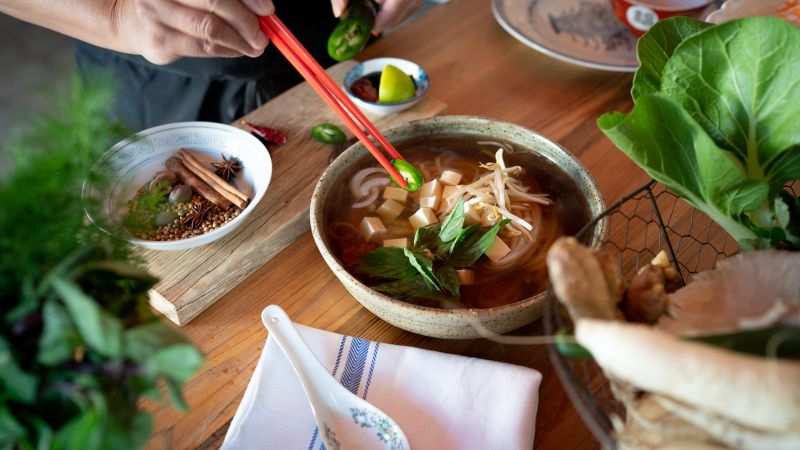
In a couple, one of a kind communities around the world, folks reside extended and heathy lives, up to and previous 100. Dubbed “blue zones,” inhabitants of these places share a common setting and way of living that scientists think add to their longevity.

The Italian island of Sardinia was where a single of the first teams of centenarians were analyzed — quickly, related prolonged-lived people ended up learned in Ikaria, Greece Okinawa, Japan Nicoya, Costa Rica and Loma Linda, California.

People today in blue zones wander, garden and bicycle as component of their every day lives. They are near to friends and loved ones, have a reason in lifetime, handle tension well, and are typically associates of a social or spiritual group. They consume a plant-centered diet plan and stop eating just before they are total.

Dan Buettner, who 1st brought blue zones into the general public consciousness with his National Geographic posts and afterwards guides, doesn’t like to get in touch with the blue zone taking in pattern a “diet.” In its place, it’s element of a balanced life style, Buettner explained, just one that he believes any individual can duplicate, no matter where they reside and take in — even in very processed, foodstuff-obsessed cultures these types of as the United States.

“The blue zone feeding on sample is 98% plant-dependent meals — full food stuff-centered and substantial carbohydrate. But only complex carbs, not the simple carbs like salty treats and candy bars and soda pop,” Buettner informed CNN. “You say carbs and people today are horrified, but the healthiest food items in our foodstuff technique are complicated carbohydrates.”

blue zones food

How healthier eating can lengthen your lifetime

Advanced carbs, these types of as beans, peas, greens and whole grains give natural vitamins, minerals and fiber that

Read More

Ideas for Curbing Psychological Eating

Ideas for Curbing Psychological Eating

Do you expertise foods cravings? Do they appear on abruptly or are they singularly focused on one style of food stuff, this sort of as carbs or sugar? If so, you may perhaps be enduring emotional or “head” hunger.

“There are various kinds of starvation,” stated Lori Knapp, a registered dietitian at ThedaCare Health care Centre-New London. “There’s bodily starvation when our physique indicators the have to have for gasoline and vitamins, and then there’s head or strain starvation when we think we’re hungry for the reason that we’re emotional about some thing.”

Knapp said it’s crucial to pay focus to each sorts of starvation.

“When our bodies notify us we’re hungry, it is critical to pay attention to that belly growl and make certain we’re offering balanced fuel to our overall body,” she reported. “A wholesome life style implies we’re conscious of what meals our system wants and we exercise aware having. That is, we consider about what our bodies require as we get ready menus, store for our food, get ready it and eat it.”

Head hunger is also a actual feeling, Knapp stated, but if we quit and assess what is going on, we could figure out it as an emotional reaction.

“Normal hunger arrives on steadily whereas head starvation commences out of the blue, or at a distinct time these kinds of as each and every evening, and usually focuses on a sharp craving for a unique sort of foodstuff,” she described. “That’s the sort of starvation that results in us to take in a bag of chips or a carton of ice cream with no contemplating, which we normally later on regret.”

Knapp indicates asking ourselves these questions right before we eat:

  • Am I genuinely hungry?
  • When did I last try to eat?
  • Am I
Read More

Industry experts share major tips for most cancers avoidance

Industry experts share major tips for most cancers avoidance

A lot of varieties of cancer are preventable. Despite the fact that threat variables these as age or genetics are not able to be changed, other threat elements for most cancers including healthy way of living selections are in your management. Elisa V. Bandera, MD, PhD and Carolyn J. Heckman, PhD, co-leaders of the Cancer Avoidance and Management Investigation Method at Rutgers Most cancers Institute of New Jersey, the state’s only National Cancer Institute (NCI)-Selected Comprehensive Cancer Center, jointly with RWJBarnabas Health, share their prime strategies for most cancers avoidance through Nationwide Cancer Prevention Month.

Try to eat nutritious meals, get going and decrease liquor intake. Ingesting a effectively-balanced eating plan, typical bodily action and retaining a nutritious human body bodyweight have quite a few overall health gains. All three components can reduce cancer threat and have been connected to much better all round well being and enhanced excellent of everyday living and prognosis right after a cancer diagnosis. American Most cancers Modern society Guideline for Diet plan and Bodily Activity for Cancer Prevention and Diet and Bodily Action Guideline for Cancer Survivors implies adopting a life-style sample that consists of having a diet of complete grains, vegetables, fruit, and beans minimizing pink and processed meat, quick meals and other processed food items high in unwanted fat, and sugars and prioritizing actual physical exercise to keep a nutritious human body weight. On top of that, liquor consumption is not proposed, as it is a carcinogen and has been discovered to raise risk for numerous cancers.

Make a plan to end using tobacco. According to the Nationwide Most cancers Institute (NCI), tobacco can maximize the possibility for quite a few forms of most cancers which includes lung, mouth, throat, cervical, blood, bladder, esophagus, stomach, pancreatic and kidney cancers. In actuality, according

Read More

Healthy lifestyle linked to lower microvascular complications risk in type 2 diabetes

Healthy lifestyle linked to lower microvascular complications risk in type 2 diabetes

January 30, 2023

2 min read


Disclosures:
Liu reports no relevant financial disclosures. Please see the study for all other authors’ relevant financial disclosures.


We were unable to process your request. Please try again later. If you continue to have this issue please contact [email protected].

Maintaining a healthy lifestyle — before or after type 2 diabetes diagnosis — was associated with significantly lower risk for microvascular complications for people with the disease, according to study data.

Results were published in JAMA Network Open.


Having a healthy lifestyle reduces the risk for microvascular complications for people with type 2 diabetes.

Data were derived from Liu G, et al. JAMA Netw Open. 2023;doi:10.1001/jamanetworkopen.2022.52239.

“The evidence regarding the association between combined healthy lifestyle before and after diabetes diagnosis and the subsequent risk of microvascular complications remains scarce,” Gang Liu, PhD, from the department of nutrition at the Harvard T.H. Chan School of Public Health, Boston, and colleagues wrote in study background. “In addition, it remains unclear whether improvements in lifestyle practice from before to after diabetes diagnosis are associated with risks of microvascular events.”

Researchers examined diet and lifestyle factors before and after diabetes diagnosis among 7,077 adults with type 2 diabetes (mean age, 61 years; 68.7% women) who were free of cardiovascular disease and cancer. All participants completed the diabetes supplementary questionnaires in the Nurses’ Health Study and the Health Professionals Follow-Up Study. Healthy lifestyles were defined as not smoking, having a healthy body weight, engaging in moderate to vigorous physical activity, consuming a high-quality diet

Read More

Association between healthy lifestyle and memory decline in older adults: 10 year, population based, prospective cohort study

Association between healthy lifestyle and memory decline in older adults: 10 year, population based, prospective cohort study

Abstract

Objective To identify an optimal lifestyle profile to protect against memory loss in older individuals.

Design Population based, prospective cohort study.

Setting Participants from areas representative of the north, south, and west of China.

Participants Individuals aged 60 years or older who had normal cognition and underwent apolipoprotein E (APOE) genotyping at baseline in 2009.

Main outcome measures Participants were followed up until death, discontinuation, or 26 December 2019. Six healthy lifestyle factors were assessed: a healthy diet (adherence to the recommended intake of at least 7 of 12 eligible food items), regular physical exercise (≥150 min of moderate intensity or ≥75 min of vigorous intensity, per week), active social contact (≥twice per week), active cognitive activity (≥twice per week), never or previously smoked, and never drinking alcohol. Participants were categorised into the favourable group if they had four to six healthy lifestyle factors, into the average group for two to three factors, and into the unfavourable group for zero to one factor. Memory function was assessed using the World Health Organization/University of California-Los Angeles Auditory Verbal Learning Test, and global cognition was assessed via the Mini-Mental State Examination. Linear mixed models were used to explore the impact of lifestyle factors on memory in the study sample.

Results 29 072 participants were included (mean age of 72.23 years; 48.54% (n=14 113) were women; and 20.43% (n=5939) were APOE ε4 carriers). Over the 10 year follow-up period (2009-19), participants in the favourable group had slower memory decline than those in the unfavourable group (by 0.028 points/year, 95% confidence interval 0.023 to 0.032, P<0.001). APOE ε4 carriers with favourable (0.027, 95% confidence interval 0.023 to 0.031) and average (0.014, 0.010 to 0.019) lifestyles exhibited a slower memory decline than those with unfavourable lifestyles. Among people who were not carriers of APOE

Read More